When a headline says the Brick Township Council "passed" an ordinance, it can mean several different things. It might have cleared a first vote with weeks still to go. It might have been finally adopted but not yet in force. So here's the question worth asking: at which point can a resident still change the outcome, and when does a new local law actually apply?
The answer is in state law, and it's the same for every ordinance, whether it sets ambulance fees, bans parking on a street, or licenses a cannabis store. This is general civic information, not legal advice.
"Passed" can mean four different things
Brick operates under the Mayor-Council Plan of the Optional Municipal Charter Law, often called the Faulkner Act, according to the township's government page. The mayor is the chief executive and the council is the legislative body. Under that structure an ordinance moves through four stages: introduction, a public hearing with final passage, the mayor's review, and an effective date. Each one is a separate event.
StageWhat happensCan the public speak?State law
1. Introduction (first reading)Council votes to introduce; notice is publishedNo hearing is required at this stageN.J.S.A. 40:49-2(a)
2. Hearing and second readingPublic hearing, then adopt, amend or rejectYes, this is the guaranteed hearingN.J.S.A. 40:49-2(b), (c)
3. Mayor's reviewMayor signs or returns it with objections within 10 daysNot a formal hearingN.J.S.A. 40:69A-41
4. Effective dateGenerally no sooner than 20 days after passage and approvalNot applicableN.J.S.A. 40:69A-181(b)
Step 1: Introduction and first reading
Under N.J.S.A. 40:49-2, an ordinance starts when the council introduces it and passes it on first reading, which can be by title alone. It must then be published in a newspaper with a notice of when and where it will be considered for final passage, a short statement of its purpose from the clerk, and where anyone can get a free copy. That publication has to come at least one week before the final vote.
A first-reading vote is not a law. It is the council saying, in effect, "this is ready for public consideration." That is the moment to read the text, because the date of the hearing is now set.
Step 2: The public hearing and second reading
This is where residents have a legal right to be heard. At the advertised meeting, the statute says "all persons interested shall be given an opportunity to be heard concerning the ordinance," including "the right to ask pertinent questions" by any resident or anyone affected by it. Final passage must come at least 10 days after the first reading.
After the hearing, the council can pass the ordinance as written, pass it with amendments, or reject it. If an amendment substantially changes the ordinance, it can't be finally adopted for at least another week, and the amended version has to be read and published again with a new notice. That's a real safeguard: the council can't quietly rewrite an ordinance at the hearing and adopt the new version the same night.
Step 3: Adoption, the mayor's 10 days, and publication
In a Faulkner Act mayor-council town, an adopted ordinance goes to the mayor. Under N.J.S.A. 40:69A-41, the mayor has 10 days to sign it or return it to the council with written objections. If the mayor does neither, it takes effect without a signature. The council can override a veto by a two-thirds vote of its members, on or after the third day after the ordinance is returned. After passage, the ordinance or its title is published again with notice of the date it passed or was approved.
Step 4: When it actually takes effect
Final passage still isn't the finish line. Under N.J.S.A. 40:69A-181(b), no ordinance other than the budget ordinance takes effect less than 20 days after final passage and the mayor's approval, unless the council adopts a resolution declaring an emergency by a two-thirds vote. Brick's own ordinances typically say they "shall take effect after second reading and publication as required by law." For the exact effective date of any specific ordinance, ask the township clerk.
Zoning changes get one more step. Ordinances that amend land-use rules are referred to the Planning Board for review under N.J.S.A. 40:55D-26 and 40:55D-64.
Where this fall's ordinances stand, and where to read them yourself
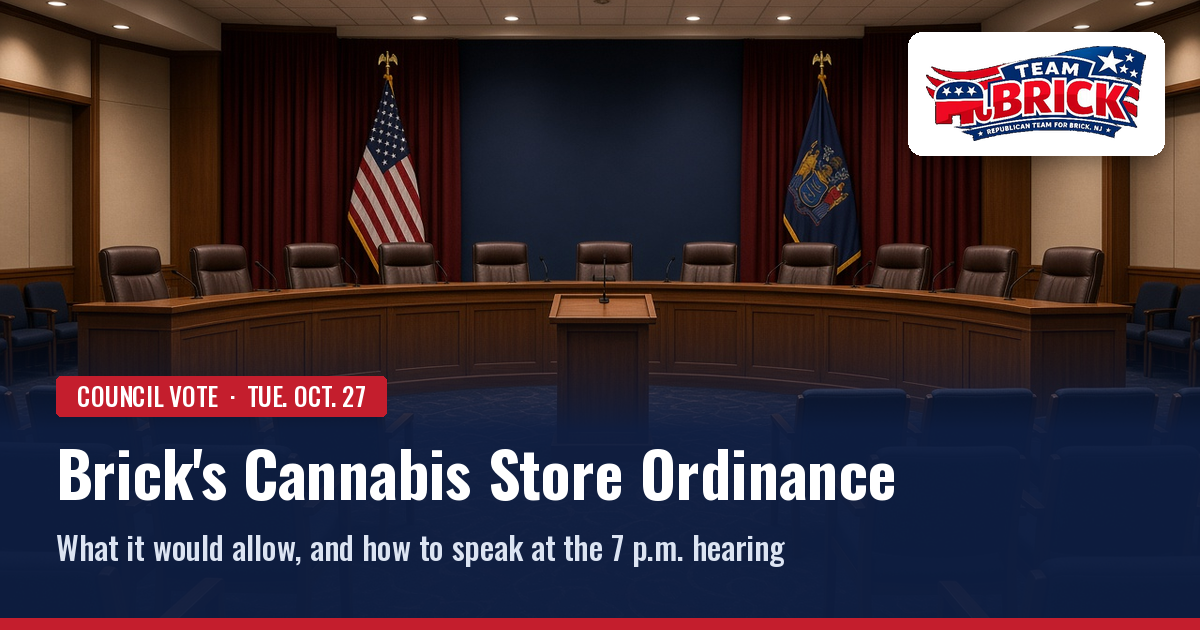
Cannabis retail license. The ordinance allowing one Class 5 cannabis retailer was introduced on first reading Oct. 13, according to its published notice in the township's Oct. 27 press package. Because it changes zoning, it went to the Planning Board, which reviewed it in Resolution R-30-2026, dated Oct. 14 and included in that package. It came up for second reading and public hearing Oct. 27, and Shore News Network reported it was adopted 6-1. Official minutes had not been posted as of this morning. Details are in our updated cannabis article.
EMS fees. An ordinance amending Chapter 175 to update the township's charges for emergency medical services was listed for first reading on the Oct. 27 agenda. Its notice sets second reading and the public hearing for Tuesday, Nov. 10, at 7 p.m. at the Municipal Building, 401 Chambers Bridge Road, if it was introduced as scheduled. We haven't confirmed the Oct. 27 introduction vote yet.
Scoop Road parking. An amendment to Chapter 288-31 prohibiting parking on Scoop Road was also listed for second reading Oct. 27.
Agendas, press packages and minutes are posted on the township's council agendas and minutes page. More official links are on our resources page.
Team Brick's view (opinion): Team Brick is a local Republican reform movement built on transparency and accountability. Open government means more than posting documents; it means residents know when their voice counts. The best time to weigh in is after introduction and before the second-reading vote.
The bottom line
An ordinance isn't settled when it's introduced, and it isn't in force the night it's adopted. Between those points is a hearing the law guarantees to every resident. Read the agenda, mark the hearing date, and show up with the question every local decision should answer: is this good for the people of Brick?