Responsible Development Starts With Neighborhoods
Team Brick isn't against growth. Here's the standard we think should decide what gets built in Brick, where those decisions are made, and how residents can be heard before they are.
Read moreFrom the Blog
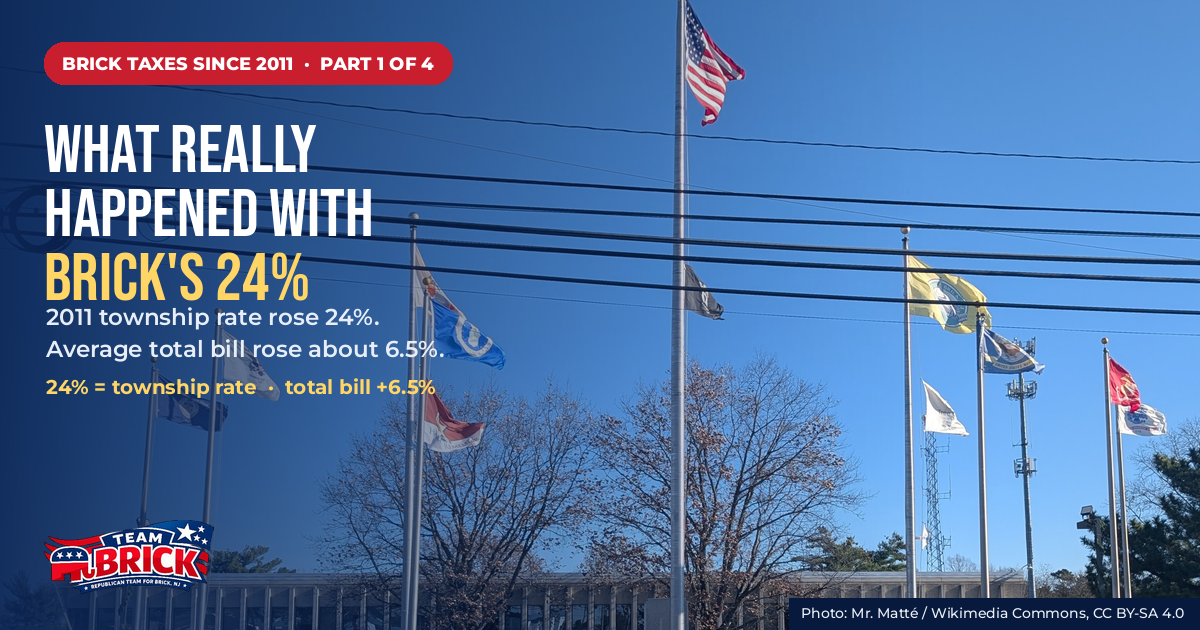
Part 1 of 4 in Team Brick's series on Brick property taxes since 2011.
For fifteen years, "24%" has been one of the most repeated numbers in Brick politics. But what actually went up 24 percent, and who decided it?
The number is real. In 2011, Brick Township's municipal purpose tax rate rose from about 51 cents to about 64 cents per $100 of assessed value. That's an increase of 24.0 percent, according to the state Division of Local Government Services tax tables. The amount the township raised through that tax went from $54.87 million to $67.82 million, up 23.6 percent. It's Brick's largest one-year increase in state data back to 1998.
A Brick tax bill pays for three main things: the schools, the county and the township. Fire districts are billed on top of that. The 24 percent applied only to the township's share.
On the average Brick home, the municipal purpose tax went from about $1,563 in 2010 to about $1,931 in 2011. That's roughly $368 more for the year. The full bill for schools, county and township together went from $5,549 to $5,907, an increase of 6.5 percent.
That was a real hit for a lot of families. It was not a 24 percent jump in the whole bill.
2011 was the first budget year under the state's new 2 percent cap on property tax levy growth. A town that wants to go over the cap has to ask its voters.
Brick did. On April 27, 2011, alongside the school budget vote, residents were asked to allow $8.6 million in spending above the cap. According to unofficial results reported by NJ.com, the question passed with 51.43 percent of the vote, a margin of 478 votes. Brick and Lambertville were the only two towns in the state where a question like this passed that day (Observer, WHYY).
The township's leaders put the question there. Mayor Stephen Acropolis, a Republican, was in his fourth year, and Republicans held every council seat. State guidance required the council to place the question on the ballot by resolution. We have not found that resolution or its roll call, so we can't tell you how each member voted. Patch reported that state law kept council members from telling residents how to vote on it.
So "the council voted to raise taxes 24 percent" isn't quite right. The council put it to voters, and voters approved it.
Officials pointed to rising costs, lost one-time revenue and the new cap. Township CFO Scott Pezzaras told Remapping Debate that Brick had lost at least $5.6 million in state aid over three years and had already cut 71 positions since 2008.
They also spelled out what a "no" vote would mean. Officials said they would lay off up to 172 employees, including 29 police officers and enough public works staff to end township trash and recycling pickup, Patch reported.
At a four-hour council meeting a week before the vote, resident Anne Coll put it plainly: "However you spin it, I can't afford it."
After it passed, Acropolis told WHYY the increase was smaller than the average cost of a private trash hauler.
For fairness: under the same administration, the municipal levy rose 11.0 percent in 2008 and 12.1 percent in 2010, the year a townwide revaluation took effect, according to the state tables. The 2011 increase was the biggest. It wasn't the first big one.
There's also a gap we haven't closed. The levy rose $12.95 million in 2011, but the referendum covered $8.6 million. We haven't seen the 2011 budget documents that would explain the difference, so we won't guess.
The increase turned political fast. In August 2011, Democratic council candidate John Ducey told Brick Patch: "It's no surprise that our property taxes in Brick have gone up 24 percent in the last year alone, with our mayor constantly out of town." That November, Democrats won four council seats. GOP Chairman George Gilmore attributed the loss to property tax increases and the revaluation, WOBM reported.
In WOBM's coverage of the 2013 mayor's race, Ducey said his Republican opponent, Joseph Sangiovanni, had been part of the team that threatened basic services in the community.
It came back in 2023. Patch reported that Democratic mailers in the mayor's race accused Republican John Catalano of being part of the council that raised taxes in 2011. An unbylined Central Jersey News piece said the Crate campaign called him "Mr. 24%." Patch also reported that Catalano was appointed to the council in August 2011, about four months after the referendum, and served until December.
We didn't find it documented in the 2025 mayor's race between Mayor Lisa Crate and Republican Madeline Colagiovanni Iannarone.
The honest version of 2011 is messier than either side's slogan. A Republican mayor and council asked voters for more money to avoid layoffs and keep trash pickup, and voters narrowly said yes. The township's rate went up 24 percent; the average total bill, 6.5 percent. Brick First means telling it that way, even when a shorter version is easier to repeat.
Next week: what happened to Brick's taxes after 2011, year by year.
Team Brick is a local Republican reform movement in Brick Township, New Jersey. This article reflects the views of Team Brick and was not written or approved by any candidate.
Header photo: Brick Township Municipal Complex. Photo: Mr. Matté / Wikimedia Commons, CC BY-SA 4.0.
Team Brick isn't against growth. Here's the standard we think should decide what gets built in Brick, where those decisions are made, and how residents can be heard before they are.
Read moreBrick's council meets Tuesday, Nov. 24 at 7 p.m. A final vote on 533 Central Ave., beach parking back for a first reading, no revaluation bids, an acting CFO, $1.87 million in year-end transfers, and how to speak. Everything on the agenda is proposed.
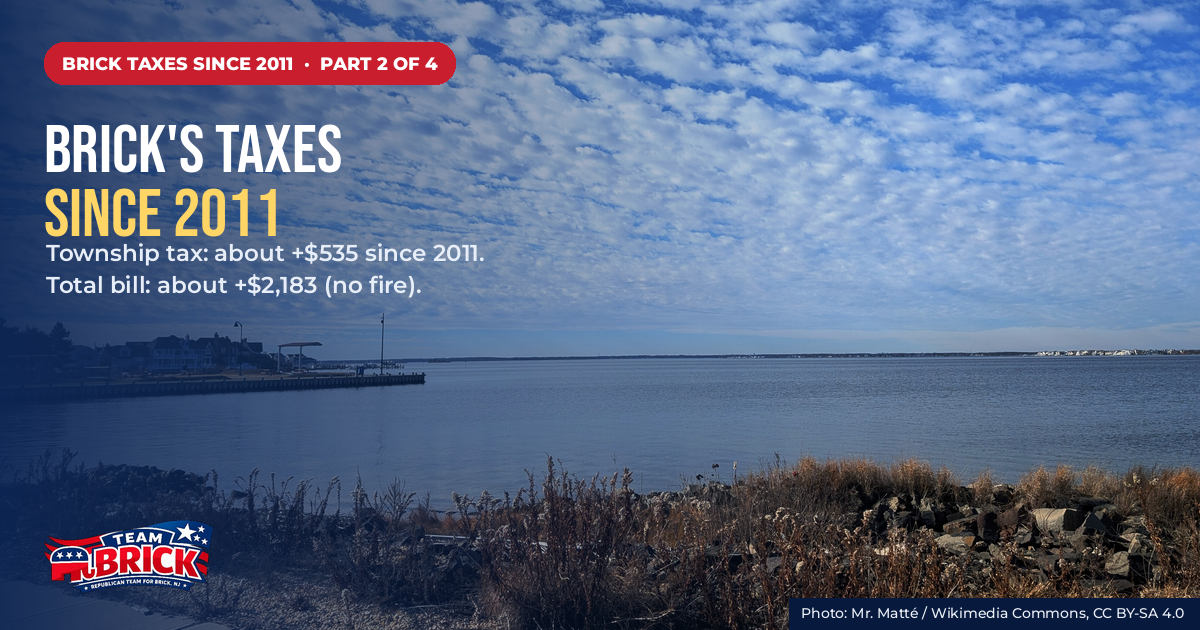
Read moreSince 2011 the average Brick home's township tax rose about $535 and the full bill about $2,183, mostly from school and county taxes. Part 2 of our tax series.
Read more