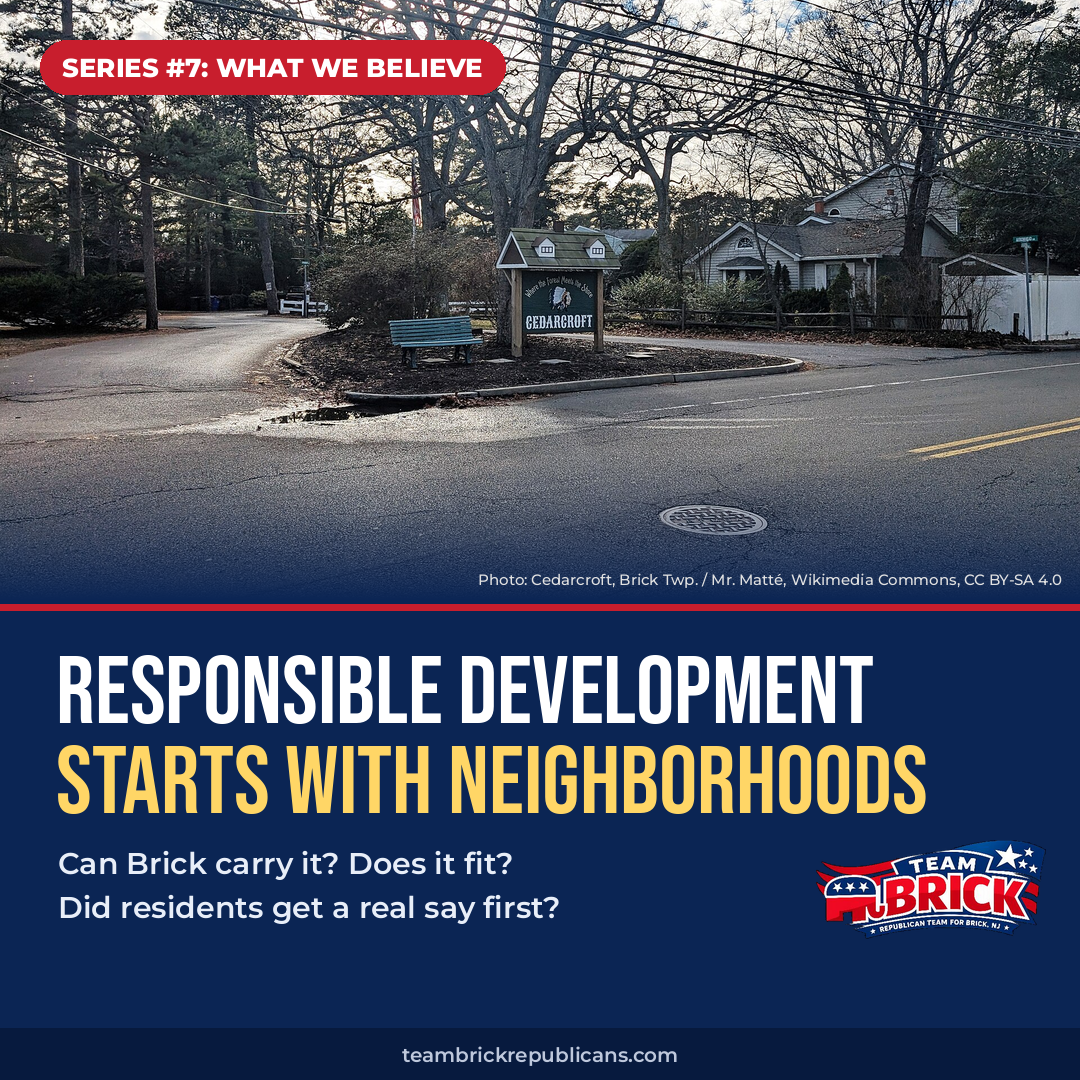
Responsible Development Starts With Neighborhoods
Team Brick isn't against growth. Here's the standard we think should decide what gets built in Brick, where those decisions are made, and how residents can be heard before they are.
Read moreFrom the Blog
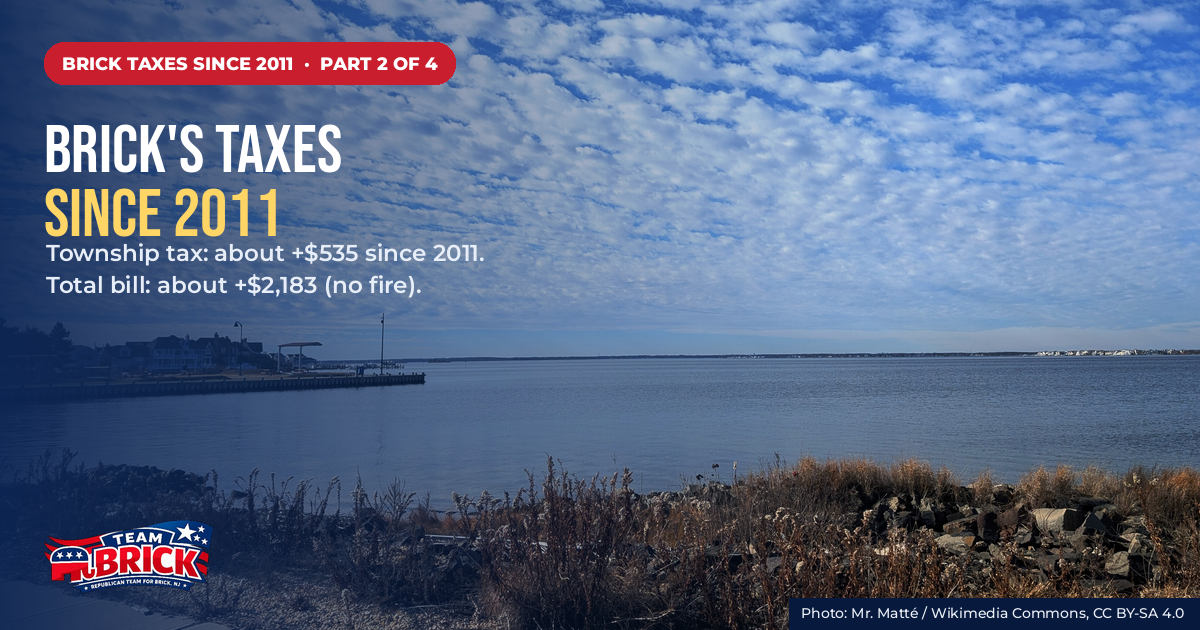
Part 2 of 4 in Team Brick's series on Brick property taxes since 2011.
Last week we looked at the 2011 referendum that raised Brick's municipal tax rate 24 percent. So what has happened to the bill in the fourteen years since?
Short answer: the township's share has grown slowly. The full bill has grown faster, mostly because of school and county taxes.
All figures below come from the state Division of Local Government Services tax tables, unless we say otherwise. "Average home" means the state's average residential assessment for Brick. Your own bill depends on your own assessment, and fire district taxes are not included.
From 2011 to 2025, the average home's township tax went up about $535, or 28 percent. The average total bill went up about $2,183, or 37 percent.
A few years stand out. The first budget under the new Democratic council majority, in 2012, came in slightly lower than 2011, and the 2013 levy dropped almost 4 percent. In 2023, the first budget under Mayor Lisa Crate held the township levy flat. Those are real results, and they belong in any fair account.
Most other years ran between about 1.4 and 4.6 percent, and 2017 dipped slightly. From 2012 through 2023, the township levy grew about 1.5 percent a year on average.
Of that $2,183 increase on the average total bill, about $535 was the township's share. About $1,076 came from school taxes and about $572 from county taxes.
From 2011 to 2025, the township levy grew 26.9 percent. The school levy grew 37.7 percent, and the county levy (including library, health and open space) grew 48.4 percent.
In 2025, schools made up about 47.8 percent of a Brick tax bill before fire district taxes. The township made up 30.9 percent and the county 21.4 percent.
That matters. The township council controls only its own share. A bigger bill reflects three governments at once, plus the fire district.
Brick reassessed every property in 2010. Assessments more than doubled overnight, and the rates were cut to match. That's why the rates before 2010 can't be compared with the rates after.
Since then, assessments have barely moved, while home prices have. The state's equalization ratio, which compares assessments to market value, fell from about 98 percent in 2014 to about 55 percent in 2025. In plain terms, the average Brick assessment now reflects a little over half of what homes sell for.
One result is easy to miss. Measured against market value, Brick's total tax rate actually fell, from 1.747 percent in 2011 to 1.465 percent in 2025. Bills went up in dollars, but home values went up faster.
The gap between assessments and market value is why the county ordered a new revaluation, which takes effect in 2029. We explained what that means in Brick's Property Revaluation: What the County Ordered, What It Costs, and What Happens Before 2029.
Here's how a few recent claims hold up against the state data.
A 2023 Central Jersey News piece said taxes under the Ducey and Crate administrations rose "an average of 1% a year." State data show closer to 1.5 percent a year for the township levy from 2012 through 2023.
The same piece said Mayor Crate's first budget had no municipal tax increase. The 2023 levy was flat, so that holds up.
During the 2025 race, Mayor Crate told Jersey Shore Online: "In the last 12 years under the Ducey and Crate Administrations, municipal taxes have increased only $38 per year." Using the state's average assessment, we got about $41 to $51 a year, depending on which year you start counting from. We don't know what method her campaign used, so we'll just say we couldn't reproduce it from the state data.
The state hasn't published its 2026 tables yet. Brick's 2026 adopted budget summary puts the township levy at $89.92 million, up 4.49 percent. It says the average home's township tax goes from $2,483.10 to $2,592.46, about $109 more. Patch reported the increase at about $98. We're using the township's own figure.
After 2011, the township's share grew at a modest pace, and in a few years it held flat or dropped. It's also true that the average bill is about $2,200 higher than it was in 2011, and that the 2011 increase is still built into every year since. Next week, in a clearly labeled hypothetical, we'll look at what that has added up to.
Team Brick is a local Republican reform movement in Brick Township, New Jersey. This article reflects the views of Team Brick and was not written or approved by any candidate.
Header photo: Barnegat Bay from Camp Osbourne, Brick. Photo: Mr. Matté / Wikimedia Commons, CC BY-SA 4.0.
Team Brick isn't against growth. Here's the standard we think should decide what gets built in Brick, where those decisions are made, and how residents can be heard before they are.
Read moreBrick's council meets Tuesday, Nov. 24 at 7 p.m. A final vote on 533 Central Ave., beach parking back for a first reading, no revaluation bids, an acting CFO, $1.87 million in year-end transfers, and how to speak. Everything on the agenda is proposed.
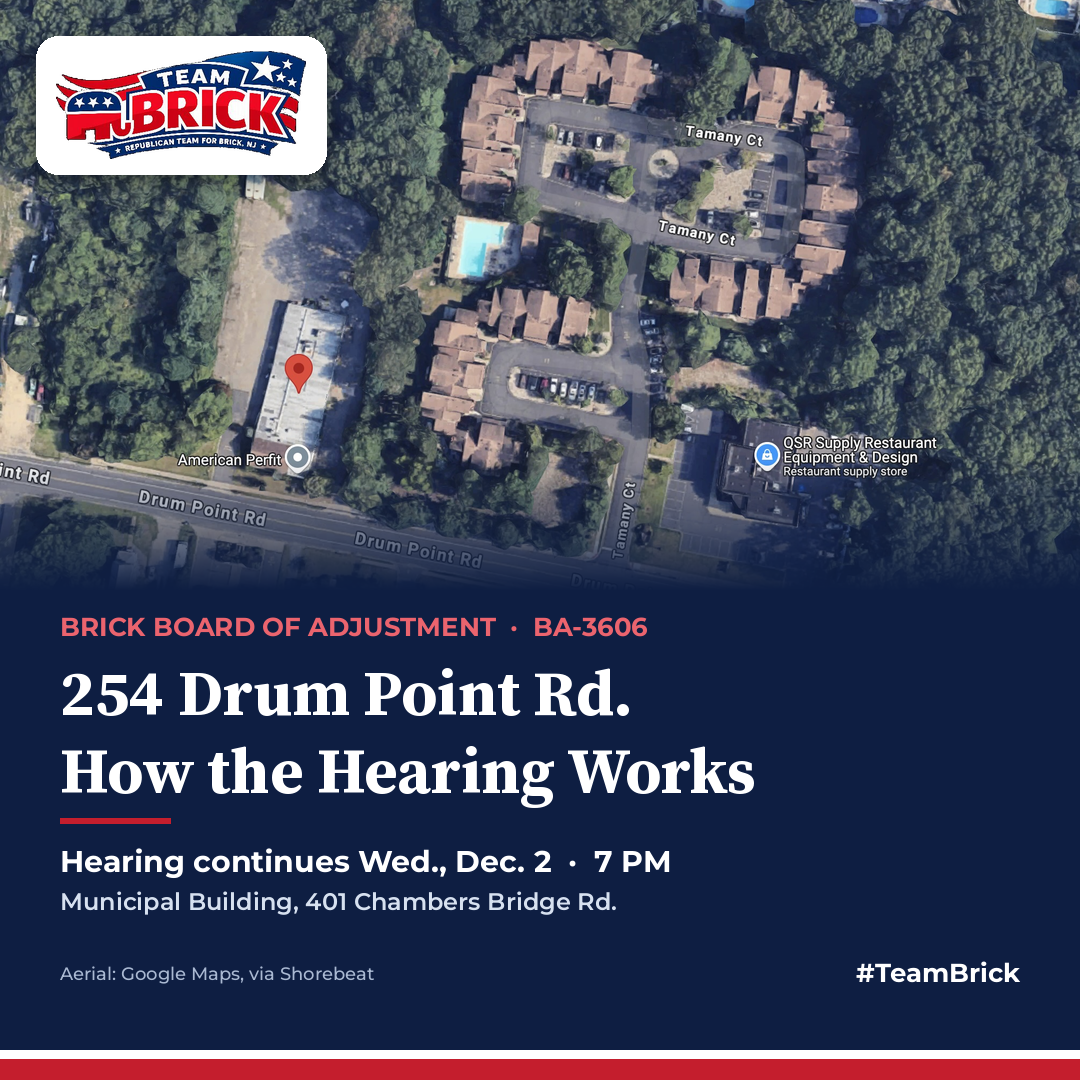
Read moreA warehouse owner on Drum Point Road wants to add a five-unit contractor-shop building and needs use and bulk variances from Brick's Board of Adjustment. No decision has been made. Here's what's proposed, what a use variance takes, and how to take part when the hearing continues.
Read more