"We're not against growth, we're against overdevelopment." Plenty of people in Brick say it, us included. The harder question is what standard actually tells the two apart, and who in Brick gets to apply it.
Earlier this month we put out a short statement, Brick First: Growth Brick Can Handle, and promised more. This is part of that.
A standard, not a verdict
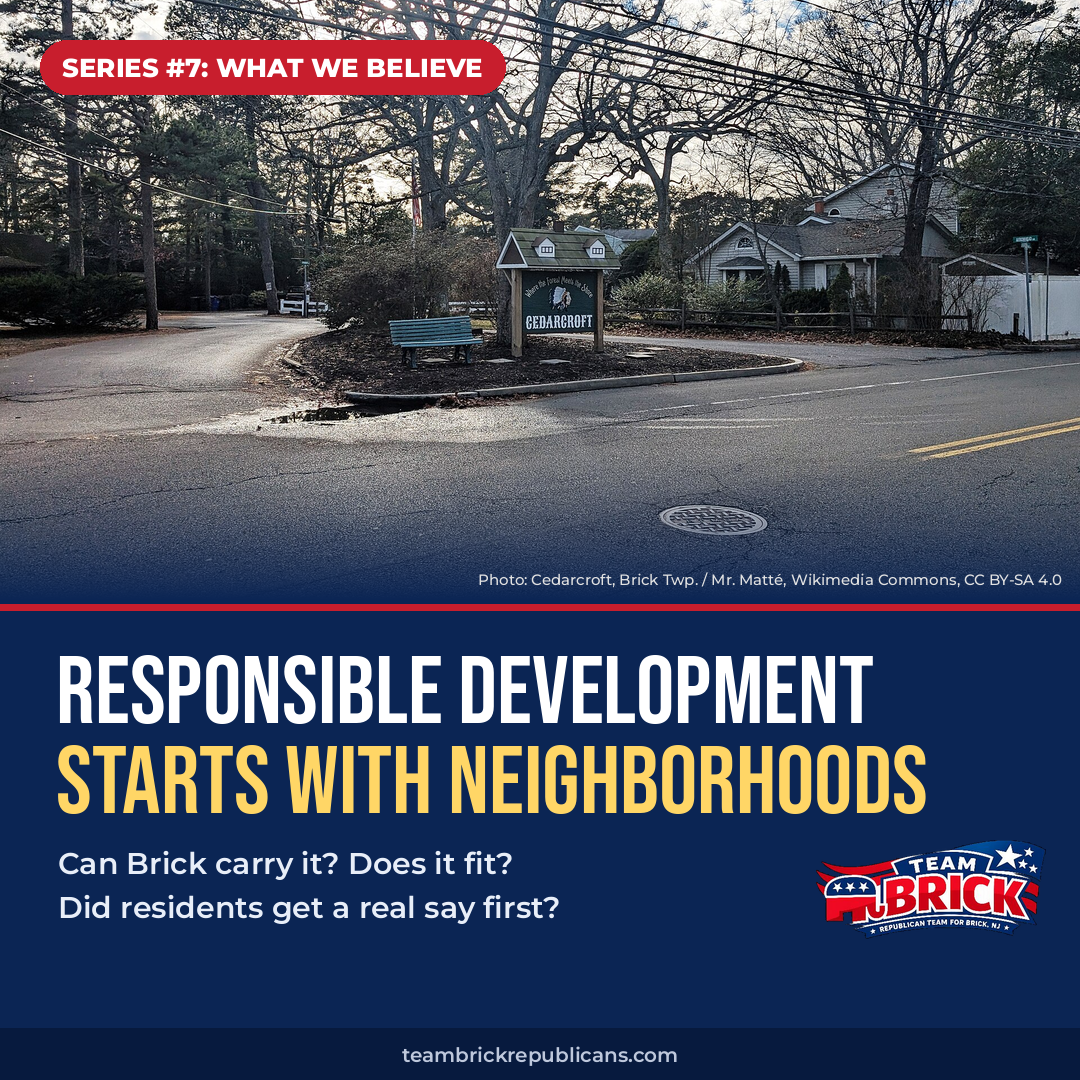
Responsible development isn't a vote for or against any one project. It's a set of questions you ask about every project, whoever is behind it. Our platform puts it this way: "We support responsible development that protects neighborhoods, respects infrastructure limits, and puts residents ahead of politically connected developers. Growth should never come at the expense of the people who already live here."
That gives you three tests, and all three start with the neighborhood.
Can Brick carry it? Roads, traffic, drainage, schools and township services all have limits. Our about page calls it "growth that protects neighborhoods and respects the limits of our infrastructure." A project that looks fine on its own lot can still overload a road or storm drain that's already at its limit.
Does it fit the neighborhood? The people who live next door should be able to recognize their street afterward. Size, use and traffic all matter.
Were residents put first? That means neighbors had a real, informed chance to be heard before the decision, not after. As we said in the Nov. 2 statement, "when a board approves something big, people should get a clear explanation of why."
Where Brick's development decisions get made
The Planning Board prepares, amends and adopts the township's master plan, which the township's own Planning Board page calls "the blueprint for the development for the township." The board also reviews zoning ordinances and reports to the Township Council before adoption, and it reviews subdivisions and site plans.
State law requires a general reexamination of the master plan and development regulations by the planning board at least every 10 years, adopted in a report by resolution (N.J.S.A. 40:55D-89). The master plan's land use element has to take natural conditions into account, drainage and flood plain areas among them (N.J.S.A. 40:55D-28). In a shore town, that matters.
The township's Master Plan documents page lists Brick's planning documents, including a 2023 Land Use Element for Resiliency. The newest reexamination report on that page is dated Aug. 22, 2018.
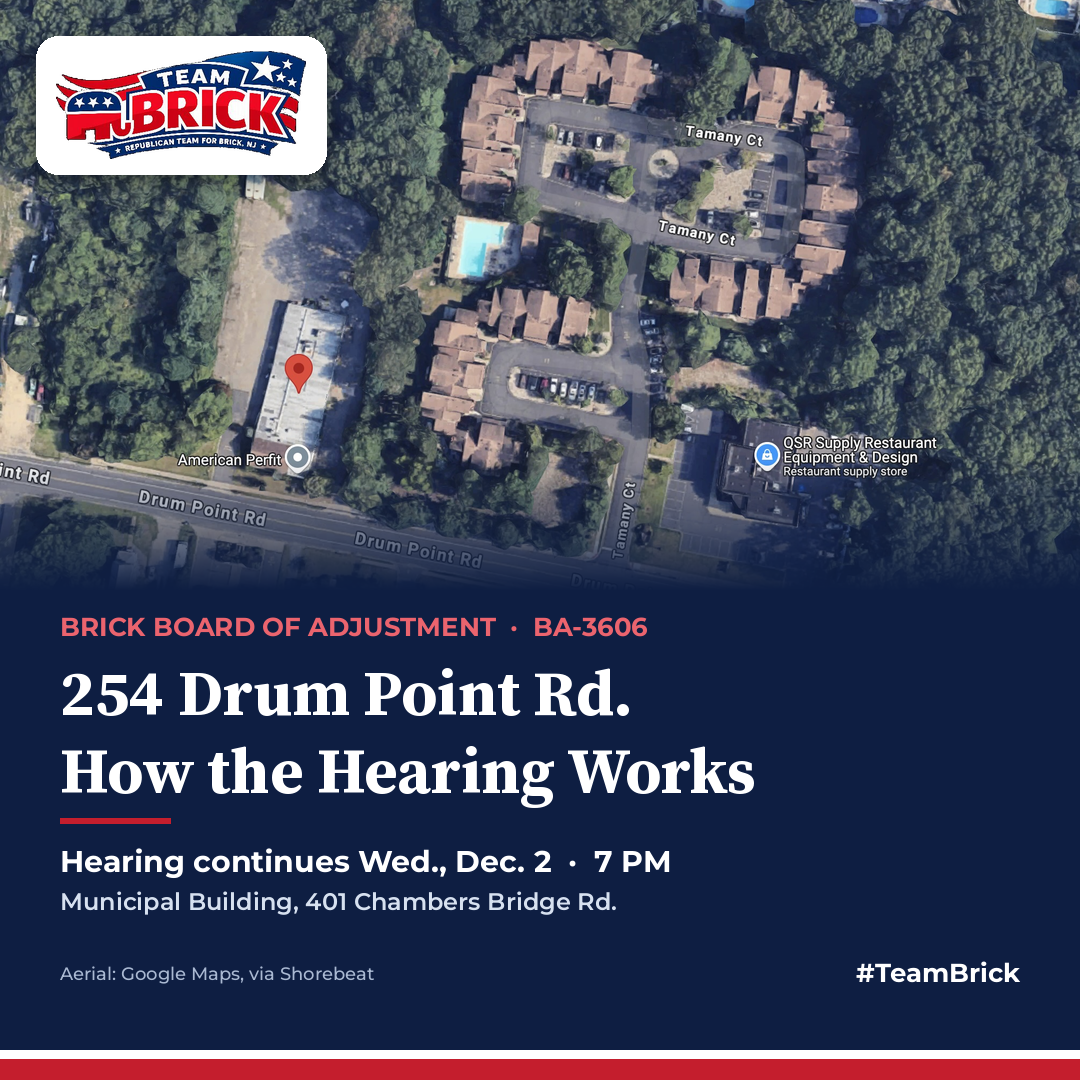
Many variance requests, where someone asks to build what the zoning doesn't allow, go to the Zoning Board of Adjustment. We walked through how a variance hearing works in our explainer on the Dec. 2 hearing.
How residents get a real say
For applications that require public notice, notice has to go to property owners within 200 feet of the site at least 10 days before the hearing (N.J.S.A. 40:55D-12). Some applications don't need it, so don't wait for a letter. Check the board pages.
Planning Board and Board of Adjustment meetings are held in person at 7 p.m. at the Municipal Building, 401 Chambers Bridge Road. Application documents can be viewed on each board's webpage, or in person at the board secretary's office from 9 a.m. to 4 p.m., Monday through Friday.
A few habits help. Read the application before the hearing. When you speak, talk about specific impacts like traffic at a certain hour, where the water goes in a storm, or how the building sits next to the houses around it. Afterward, read the board's written decision. We covered how to find township records in Transparency Should Be a Habit.
What the tests look like in practice
Two hypotheticals show how this works. They're made up to illustrate the standard and don't describe any real application, property or developer in Brick.
Hypothetical one: the rush-hour road. Imagine a project proposed on a road that already backs up every weekday at rush hour. The question isn't whether the building looks nice. It's what the added trips do to that road and what anyone plans to do about it. If nobody can answer that in plain language, the board and the public don't have what they need yet.
Hypothetical two: the low block. Imagine a plan to pave over a lot at the bottom of a street where backyards already hold water after a heavy rain. The drainage plan is the heart of that application. Neighbors who know where the water sits are some of the best witnesses a board can hear from.
In both cases the standard isn't "no." It's "show us it works for the people who already live here."
What we'll hold leaders to
Brick First means growth on Brick's terms. That's what we'll keep asking of the people who make these decisions: respect the limits of our roads, drainage and schools, protect the neighborhoods that are already here, make hearings easy to find and follow, and when a board approves something big, explain why in plain terms.
Every project, large or small, gets the same question: is this good for the people of Brick?
If that's the kind of township you want, read our platform, keep an eye on the Planning Board and Board of Adjustment pages for upcoming hearings, and come to a Team Brick meeting.
Team Brick is a local Republican reform movement in Brick Township, New Jersey. This article reflects the views of Team Brick and was not written or approved by any candidate. Statute summaries are plain-language and not legal advice. Photo: Cedarcroft, Brick Township, by Mr. Matté via Wikimedia Commons, CC BY-SA 4.0.