Responsible Development Starts With Neighborhoods
Team Brick isn't against growth. Here's the standard we think should decide what gets built in Brick, where those decisions are made, and how residents can be heard before they are.
Read moreFrom the Blog
Team Brick says it won't take marching orders from any political machine. But Brick doesn't run on its own. It shares roads with Ocean County, answers to state law, and works alongside a separate Board of Education. So what does independence actually commit a local leader to, and when does it turn into an excuse not to work with anybody?
When we wrote Republican Values, Brick Priorities, we said we would come back to how that balance works in practice. This is that piece.
Independence is about judgment. The reason behind a vote, an appointment or a public position should be what it does for Brick, not who asked for it or what someone gets for going along.
Our platform says it directly: "Local elected officials should answer to Brick residents, not county bosses, machines, donors, insiders, or personal ambition. We will work with anyone who wants to do right by Brick, but we will not support a system where local decisions reward political loyalty or serve outside power structures."
Notice the middle of that. Independence doesn't mean opposing the county or the state on reflex, refusing to work with other Republicans or anyone else, or treating every disagreement like a fight. Our about page describes the problem we're trying to avoid: "Candidates should not be chosen simply because they are connected, convenient, or willing to follow orders." Following orders is the problem. Working with people isn't.
A lot of what affects people in Brick isn't controlled by the township alone. Lanes Mill Road is one we've already written about.
In September, the Township Council voted to lower the speed limit on Lanes Mill Road from 40 to 35 mph near Brick Memorial High School. As our statement on the vote pointed out, Lanes Mill Road is an Ocean County roadway. We supported the vote and asked for, among other things, "Regular coordination between Brick Township, Ocean County, the Brick Township Police Department and the Board of Education."
We also said this: "There may legitimately be several different governmental bodies involved, but the people who live here do not care which letterhead is on the solution. They want the problem solved."
State law makes room for this. Under the Uniform Shared Services and Consolidation Act (N.J.S.A. 40A:65-1 and following), a local unit such as a town, a county or a school district can agree with another local unit to provide or receive a service that each one is allowed to provide on its own (40A:65-4). A local unit enters an agreement like that by adopting a resolution (40A:65-5). So when governments share a service, there should be a resolution on a public agenda you can look up.
A few hypothetical situations make the line clearer. These are examples to show how the test works. They don't describe anything that has happened in Brick.
Example one: good help from the other party. Say a county or state program would genuinely help Brick residents, and the officials offering it belong to the other party. The Brick First answer is to take the help and tell residents why. Turning down something useful because of who's offering it is just partisanship.
Example two: a request from outside Brick. Say a party organization outside Brick wants a local appointment or vote to go a certain way, and nobody explains to residents why. That's where cooperation ends. The reason for a local decision has to be a Brick reason, said out loud.
Example three: a problem nobody owns. Say two governments each claim a problem belongs to the other one. Cooperation means sitting down, settling who will do what and by when, and making that public.
The tradeoff is real. Working closely with other governments can blur accountability, and keeping your distance can leave problems unsolved. The way through is to cooperate in the open and keep the reasons local.
You don't have to take anyone's word for it, ours included. Watch for this:
The township posts council agendas and minutes on its Council Meeting Minutes & Agendas page. Look there for resolutions that name another government. We covered finding the record in Transparency Should Be a Habit.
If you're independent but won't cooperate, you're mostly just posturing. If you cooperate but give up your independence, you end up taking orders. Brick needs leaders who know the difference and explain their choices. County road, state program or a request from party leaders, the test is the same: is this good for the people of Brick?
If that's how you think local government should work, read our platform and come to a Team Brick meeting.
Team Brick is a local Republican reform movement in Brick Township, New Jersey. This article reflects the views of Team Brick and was not written or approved by any candidate.
Team Brick isn't against growth. Here's the standard we think should decide what gets built in Brick, where those decisions are made, and how residents can be heard before they are.
Read moreBrick's council meets Tuesday, Nov. 24 at 7 p.m. A final vote on 533 Central Ave., beach parking back for a first reading, no revaluation bids, an acting CFO, $1.87 million in year-end transfers, and how to speak. Everything on the agenda is proposed.
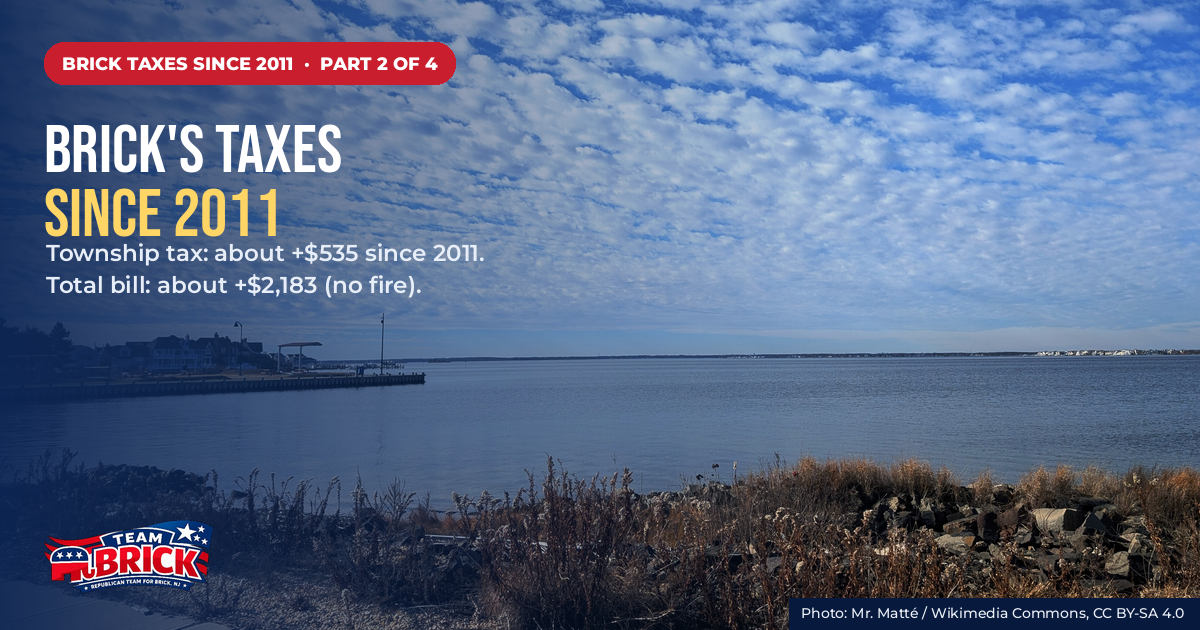
Read moreSince 2011 the average Brick home's township tax rose about $535 and the full bill about $2,183, mostly from school and county taxes. Part 2 of our tax series.
Read more